


Most Common Questions
Why are my numbers different in Measure/Unified Dashboards in Analyze than the native platform?
Because the API and native metrics are built using different measurement approaches, those differences are expected and normal. This has been consistent over time and will remain so in future comparisons.
Instagram:
There can be several reasons why the metrics for a 3rd party platform don’t match the native platform. Here are the most common reasons why our data may differ from Instagram natively:
- Metrics on native platforms update in realtime, while updates to 3rd party platforms don’t happen as frequently. We’ll poll the API once every 6 hours to update the data we have in the platform.
- It’s possible you may be comparing Meltwater’s Post-Level metrics with the native platform’s Page-Level metrics.
- Within Meltwater, we provide several Post-Level metrics, while all of the data natively are Page-Level metrics.
- Post-level metrics: Only organic Instagram posts are included in these metrics.
- Page-level metrics: Meta combines organic and data from Facebook ads targeting Instagram.
- More information can be found here about Page vs Post-level
- Instagram does not track impressions for Reels, instead Plays are used as a substitute for Impressions.
- Instagram Reels: Due to an API limitation, the engagement data we receive for Instagram Reels only reflects interactions made directly within the Instagram app. When a Reel is also shared to Facebook, those engagements aren’t included in the API data. However, Meta’s native reporting does include them, which can result in lower engagement numbers appearing on the Meltwater platform.
Facebook:
There can be several reasons why the metrics for a 3rd party platform don’t match the native platform. Here are the most common reasons why our data may differ from Facebook natively:
- Within Meltwater, we provide several Post-Level metrics, while all of the data natively are Page-Level metrics.
- Metrics from Facebook are updated once every 24 hours.
- Facebook Reach: Reach is referred to as unique users, meaning no matter how many times they view the content it still counts as one.
- Meta Business Suite includes metrics like interactions and link clicks from stories and ads not published on your page, however, due to API limitations, Meltwater includes engagements and clicks from ads and posts published to your page.
- Meta Business Suite also includes an Interactions metric that does not include clicks, unlike Meltwater’s engagement metric, which accounts for clicks.
What are the differences between Organic, Boosted, Dark, and Ad posts? Where can we find each in the Meltwater platform?
What is considered an organic post? Where will we see organic posts in Meltwater?
Organic posts are pieces of content that are posted directly to a brand’s page without boosting/promoting the post or using the ads manager to create the post.
This data can be found in:
-
Analyze: Organic posts can be found in Analyze by using the Owned widgets we have available.
-
Measure: Organic posts can be found in Measure by using one the overview templates (i.e., Facebook Overview), or through our Paid, Earned & Owned template where (owned) widgets will include Organic content.
What are dark posts? Where will we see dark posts in Meltwater?
Dark posts are created when an ad is based on an existing organic post when adding additional parameters like audience targeting or call-to-action buttons. These posts are classified as advertisements, and not boosted posts.
These can be found in:
-
Analyze: Dark posts are included in the Paid widgets we have available in Analyze.
-
Measure: Dark posts are included in the Paid templates we have available in Measure, or through our Paid, Earned & Owned template where paid widgets will include paid data.
What are ad posts? Where will we see ad posts in Meltwater?
Ad (or Campaign) posts are created using a platform’s ads manager and include additional parameters like audience segmentation and customizable formats like carousels and call-to-action buttons. These posts can be found on a brands’
These can be found in:
-
Analyze: Ad posts are included in the Paid widgets we have available in Analyze.
-
Measure: Ad posts are included in the Paid templates we have in Measure or through our Paid, Earned & Owned template where paid widgets will include paid data.
What are boosted (promoted) posts? Where will we see boosted posts in Meltwater?
Boosted (or promoted) posts are organic posts that received additional amplification by the brand to increase visibility.
These can be found in:
-
Analyze: Boosted post metrics can be found in Owned TikTok, X, and Facebook widgets.
-
At the time of this article update, we’re currently displaying boosted and organic data together in the Owned Facebook widgets. We’re looking to update these with filters in early 2026.
-
-
Measure: Boosted post metrics can be found in TikTok, X, and Facebook reporting or through our Paid, Earned & Owned template where the paid widgets will include paid data.
-
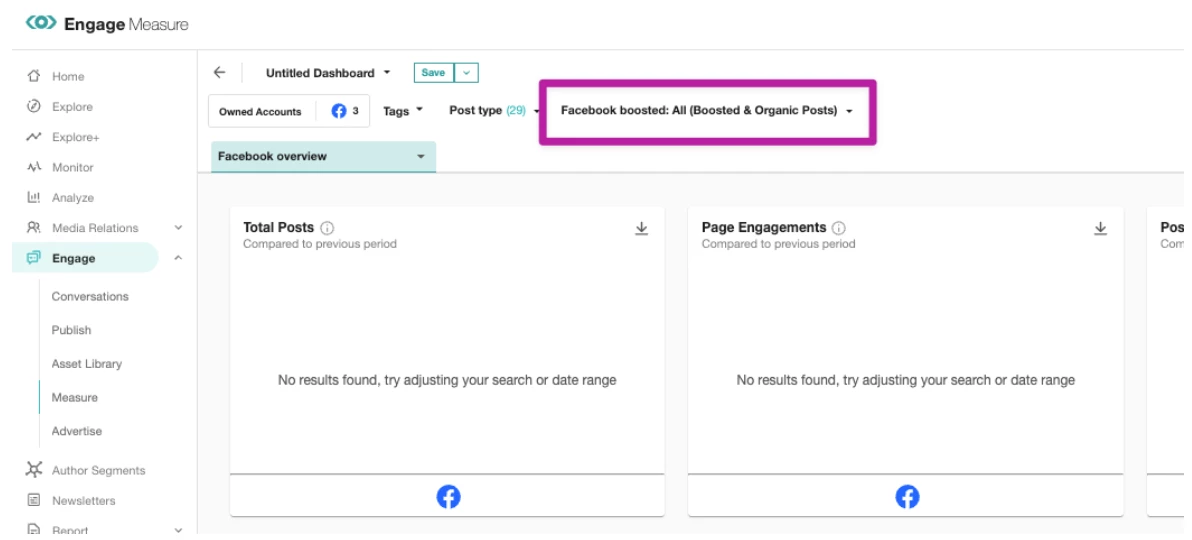
Facebook includes Boosted data so long as the Overview dashboards’ setting is set to “All”.
-
How often does data update in the Meltwater platform for Owned/Paid data?
- These platforms update once every 24 hours:
- Facebook Competitive, Owned, Paid
- TikTok Owned
- Linkedin Owned
- These platforms update once every 6 hours:
- Instagram Competitive, Owned, Paid
- LinkedIn Paid
- TikTok Paid
- YouTube Owned
How long is data collected for each platform (post-level)?
- These platforms include 30 days of data collection:
- LinkedIn Owned & Paid
- Instagram Owned & Paid
- Facebook Owned & Paid
- TikTok Paid
- These platforms include 60 days of data collection:
- TikTok Owned
- YouTube Owned (paid data not available in Meltwater)
- X (Twitter) is the only platform that collects data for 7 days.
Note: Page-level metrics are continuously updated
Is the length of time we collect data an API limitation, or a decision made by Meltwater to collect data for this timeframe?
The length of data collection is a decision made by Meltwater due to rate limiting in the API from the various social platforms.
Facebook FAQs
What are the differences between Ads and promoted posts on Meta/Facebook?
Meta offers multiple advertising options for Facebook and Instagram, allowing you to tailor campaigns based on your marketing objectives.
Promoted/Boosted Posts
-
A boosted post is an organic post amplified through paid promotion to increase its visibility on Facebook or Instagram.
-
Boosted post data is available in the Facebook overview template for tracking performance.
Ads and Campaigns
-
Ads offer advanced features like audience segmentation and customizable formats, including carousels and call-to-action buttons.
-
Ads follow a hierarchical structure: Campaign > Ad Sets > Ads.
-
Best for objectives like driving website traffic or direct purchases, these are included only in Paid analytics templates.
Dark Posts
-
A dark post is created when an ad is based on an existing post but includes edits like refined audience targeting or call-to-action buttons.
-
These posts are classified as advertisements, not boosted posts.
How often does data update in the Meltwater platform for Facebook Owned/Paid data?
We update Facebook metrics once every 24 hours.
How long is Facebook data collected after publishing?
Both Owned & Paid Facebook data is collected for 30 days after publishing.
- Note: Page-level metrics are continuously updated
Is the length of time we collect data an API limitation, or a decision made by Meltwater to collect data for this timeframe?
The length of data collection is a decision made by Meltwater due to rate limiting in the API from the various social platforms.
Learn more about Facebook Analytics in Measure.
Instagram FAQs
Why am I seeing "Views" instead of "Impressions" or "Plays" for my Instagram metrics?
Instagram has transitioned to using views as its primary performance metric, with the change taking effect on April 21, 2025. Impressions and Plays have been phased out. Read more here.
The following metrics have been deprecated moving forward, but all historical data is still available:
-
Post reels plays
-
Post reels replays
-
Post reels total plays
-
Page impressions
-
Post impressions
Historical data will still use Plays and Impressions.
As of November 15, 2025, Meta has removed page fans and page/post impressions. Due to this, after November 15, 2025 users will see impressions data replaced with Views data. You can find more information about this update here.
The metrics have not been renamed. Impressions and Plays are now being populated using the Views metric from Instagram moving forward with historical data using the legacy metrics.
Page impressions has also been updated to use “Views” as the new metric from Instagram.
How often does data update in the Meltwater platform for Instagram Owned/Paid data?
We update Instagram metrics once every 6 hours.
How long is Instagram data collected after publishing (post-level)?
Both Owned & Paid Instagram data is collected for 30 days after publishing.
Note: Page-level metrics are continuously updated
Is the length of time we collect data an API limitation, or a decision made by Meltwater to collect data for this timeframe?
The length of data collection is a decision made by Meltwater due to rate limiting in the API from the various social platforms.
Learn more about Instagram Analytics in Measure.
General FAQs
What are the differences between page-level and post-level metrics?
Page-Level Metrics
-
Reflect all activity during the selected date range, across all posts on a Page, regardless of when the posts were published.
-
Example: Page video views include total views received within the date range, even if the videos were published before that period.
Post-Level Metrics
-
Only account for posts published within the selected date range.
-
Example: Post impressions are limited to posts created during the chosen timeframe, offering a more focused view of recent content performance.
Learn more about Page-Level and Post-Level Data.
Do weekly metrics track all activity or only posts published that week?
Post-Level Metrics
-
New engagements on a post are attributed back to the original post date.
-
While the post receives updates, the metrics are displayed in the context of the original publication date.
Page-Level Metrics
-
Engagements are updated in real-time and reflect ongoing activity on the page.
-
These metrics include all engagements on the page, regardless of when the post was originally published.
How do I view top posts from a specific time period?
You can easily identify your top-performing posts within a selected date range. Simply sort your posts by key performance indicators like impressions, engagements, or engagement rate to see which content resonated most during that time.
Can you track both paid and organic campaigns?
It depends on the platform:
-
Meta (Facebook & Instagram): Provides data for both paid and organic campaigns.
-
X (formerly Twitter): Only offer metrics for organic content.
-
LinkedIn: Provides data for both paid and organic campaigns.
Understanding these limitations can help you tailor your reporting for each platform.