



“Fore!” - How my team used Meltwater to navigate a high-profile crisis event, plus 6 things we would do differently today

When you're a public affairs firm working in and for the public sector, you want things to be boring. Not in the sense that you want your employees to languish in daily drudgery, but you really hope, for your clients' sake, that they don't find themselves in the spotlight due to some exciting or salacious incident. When you've seen the things we've seen, you realize there is a reason people consider the expression, "may you live in interesting times," more a curse than a blessing.
In this post, Tripepi Smith Principal @JonBarilone and I provide a behind-the-scenes look at how Meltwater aided our crisis communications response involving one of the most famous athletes in the world, including how the Tripepi Smith team monitored a breaking news situation, leveraged media intelligence to generate talking points for critical stakeholders, and kept our finger on the pulse of the media's fluctuating coverage.
One more thing to keep in mind about this story: all of this happened when Tripepi Smith was still a brand-new Meltwater client! When this incident occurred, it had been just five days since we’d created our user accounts and had our very first onboarding call with our Meltwater rep. Since then, we’ve grown leaps and bounds, and we’re able to use over two years of hindsight to reflect on what we wish we had done differently.
When You're International News Before Noon
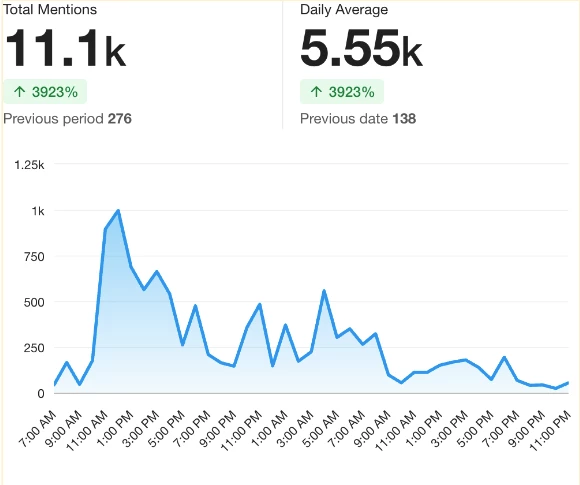
On Tuesday, February 23, 2021, shortly after 7 a.m., Tiger Woods was involved in a single-car rollover crash in the greater Los Angeles region known as the Palos Verdes Peninsula. Word got out quickly: television news helicopters, photographers, and reporters all descended on the site that morning to capture visuals and interview nearby neighbors.
Within a few hours, headlines splashed across media outlets with tens of millions of readers: NY Times, CNN, Washington Post, Forbes, CNBC, Fox News, ESPN.com, USA Today, and Yahoo News were just a few of the huge outlets covering the story. Even international newspapers such as the Guardian and the Daily Mail were running up-to-the-minute coverage on Mr. Woods and his condition.
A Lot of Cooks in the Kitchen
As straightforward as an accidental car crash sounds, the result was anything but. The parties involved included two cities and their attorneys, one insurance authority, two county public safety departments, and our public affairs firm—not to mention two regional medical centers—all desperate to stay one step ahead of the media flurry.
Let’s review the general timeline now - this will also introduce you to just a few of the most important parties involved:
- The crash began on Hawthorne Boulevard, a stretch of road within the boundaries of the City of Rancho Palos Verdes.
- The crash ended on that same road, but now within the boundaries of the City of Rolling Hills Estates. Fun fact: The City Manager of Rolling Hills Estates quickly grabbed the smashed "Welcome to Rolling Hills Estates" road sign to stop it from becoming a collector's item!
- The two cities immediately alerted the California Joint Powers Insurance Authority (you might remember the California JPIA from my post about Daily Newsletters!)
- Naturally, both cities' attorneys immediately became involved in reviewing every media statement/response.
- The L.A. County Sheriff's Department and L.A. County Fire Department responded to the crash, extracting Mr. Woods from his vehicle and investigating the site.
At the time, two Tripepi Smith clients were directly involved in the incident: Rolling Hills Estates and the California JPIA. Rancho Palos Verdes quickly became our temporary client by way of the California JPIA, who provided the insurance coverage for the city.
If this all seems confusing - it is! This should give you an idea of the number of “cooks in the kitchen” when it came to the public response to this incident.
Three years before the crash, our team had set up an as-it-happens Google Alert to monitor previous media mentions about Rolling Hills Estates, but it only searched for the actual phrase: "rolling hills estates." This too-specific search resulted in delayed notification of this incident, since it didn’t include Rancho Palos Verdes. While the crash happened sometime around 7 a.m. that morning, our Google Alert email didn't come until 1:50 pm! 😱
As our various teams jointly reviewed the full firehose of news results from the first 72 hours following the crash, it dawned on us: since the crash spanned two cities, our search for just "rolling hills estates" was not going to show us everything we needed to see. Sometime between February 26 and March 3, we configured our first Meltwater search surrounding the incident.
As new users, we had to improvise based on fairly limited platform knowledge. Using the simplified "Keyword search" function within Explore, we looked for all mentions of "Tiger Woods," but only when combined with either "Rancho Palos Verdes" or "Rolling Hills Estates." This instantaneously improved the quality of our data and helped us keep a close eye on news and social chatter as events unfolded.

Identifying Questions and Misinformation
By the early morning hours of Wednesday, February 24, it was clear that Mr. Woods’s injuries were extensive. The Harbor-UCLA Medical Center confirmed several emergency surgeries, including the insertion of a metal rod, screws and pins to stabilize the shattered bones in his right leg. It was possible this would be a career-ending injury.
That would have been big enough news on its own, but a 15-word quote from one resident of Rolling Hills Estates printed in a February 26 Washington Post article would take us down a rabbit hole: "I would describe this stretch as pretty hazardous. People go off the roadway pretty frequently."
This quote, combined with the worldwide shock of Mr. Woods's surgeries and the seriousness of the crash energized the media, and the onslaught began. Suddenly, the public conversation shifted from "How much is the driver at fault?" to "How much is a 'hazardous condition’ at fault?" It didn't help that the LA County Sheriff’s Department repeated the claim that Hawthorne Boulevard was a "hazardous roadway." We needed to take swift action to keep this off-the-cuff comment from becoming the center of the public discourse.
In the following weeks, our Meltwater keyword search and our daily Newsletter digest became valuable tools as we sought to do a few specific things to support our clients:
- Identify questions the media was asking, so we could form specific responses.
- Identify misinformation in media coverage, particularly about the safety of the road.
- Identify local/regional reporters who were writing multiple stories about the crash so we could connect with them directly.
- Monitor published statements from the Sheriff’s Department, in case they hadn't been shared with us beforehand, so we could issue corrections or comments as needed.
And the Beat Goes On
After the first couple weeks, there was a relative lull in the media frenzy. Mr. Woods was recovering, the LA County Sheriff’s Department was investigating, and our teams were busy gathering studies and expert testimonies to combat the misinformation about the safety of the road.
During this downtime, we at Tripepi Smith set up a Meltwater Spike Alert so we would know if/when there was a resurgence of interest (we used the same “Tiger Woods” + “Rolling Hills Estates” or “Rancho Palos Verdes” keyword search above).
We got our first Spike Alert email on April 1st when the Sheriff’s Department stated they knew the cause of the crash, but were waiting to share during a yet-to-be-scheduled press conference. That press conference was held almost a week later, on April 7. Right on cue, we received another Spike Alert as media outlets latched on to the latest update from the press conference: “Tiger Woods was driving at unsafe speed when he was injured in crash, sheriff’s office says.”
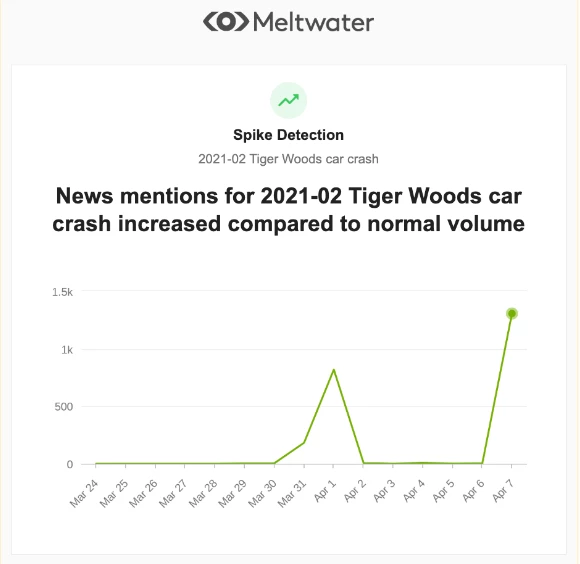
With these Spike Alerts in place, we didn't have to play as much catch-up as when the incident first happened. We were able to get to work right away. We drilled down into the insights within Meltwater to find out exactly what media outlets were saying and what new questions/concerns we needed to address.
If We Knew Then What We Know Now…
When the incident happened, we hadn't even completed our first Meltwater Training session. I would love to tell you that we immediately set up a comprehensive Boolean search that showed us everything we needed to see and excluded everything we didn't, but we just weren't that knowledgeable or advanced yet.
If we'd had the expertise and toolset we now have today, here are six things we would have done differently:
- Start with a basic Spike Alert for Rolling Hills Estates to avoid the seven-hour gap between the incident and our notification. Since then, our team has adopted this as a best practice when onboarding new clients to keep us ahead of the news.
- Before setting up the search, agree with stakeholders on a clear objective for it; in this case, the goal of the search was to inform our communications and minimize liability for the cities involved.
- Create an advanced Boolean search that could be tweaked to fit our evolving needs. For example, as the safety of the road came into question, we could have easily added to our basic search for “Tiger Woods” AND (“Rolling Hills Estates” OR “Rancho Palos Verdes”) to include mentions of Hawthorne Blvd, along with negative sentiment mentions related to it.
- Set up Custom Categories (they didn’t exist yet at the time of this incident, but are now an essential part of our process) for current Rolling Hills Estates and Rancho Palos Verdes leadership and static terms related to the incident. This would allow us to simplify the Boolean string in the main search, enabling more comprehensive, modular adjustments on the fly.
- Monitor the social media usage of local elected officials to get ahead of any statements that had not been approved by all parties.
- Create Custom Dashboards to show media hits, trending topics, most popular content and other key metrics (sentiment, top influencers, engagement, etc.) at a glance.
In Conclusion
All organizations must weather “interesting times” eventually. This story is a larger-than-life example of what can happen when a “boring” municipal client becomes the center of an international news story, but the lessons here apply to nearly any crisis. Staying informed is vital to managing an organization's reputation and responding effectively to a crisis, and our own brush with celebrity illustrates how Meltwater helped us keep up with the media flurry.
Training your crisis response team to effectively use the platform during challenging times is important. I shared a few of the ways experience and comprehensive training have helped our team unlock even greater success guiding crisis response and addressing misinformation, but now it’s time for you to speak up! Pick a question or two and let us know:
- What’s the craziest event that’s ever happened on your watch?
- What crisis monitoring practices do you lean on in challenging times?
- Do you use any ready made searches you can edit for real-time incident monitoring?
- Do you lean more on local publications or journalists for your updates?