



Experts: Internal Engagement - Employees as your best content advocates
If the key to building community on social media is in facilitating truly meaningful relationships with my followers, then how do I cultivate the kind of trust that results in valuable and authentic interactions?
Here’s the thing: it all comes back to authenticity and being a voice that is deemed trustworthy. From testimonials to reviews, so much of online branding is rooted in the assurance that the brand, company, and/or product is worthy of gaining and keeping your followers’ trust.
And what better way to build that than from the inside out? It turns out that one of your greatest assets for building out a meaningful engagement circuit on social media is your own team!
Leveraging the very people who know your brand and product best of all is powerful for several reasons. Key areas in which employee social media advocacy can positively impact your brand include:
-
It’s a smart brand move. Your employees have their own networks that often reach far beyond your brand’s core community. Employee outreach to their personal circles can help increase your brand’s reach with minimal effort.
-
It’s great for PR. Having employee voices weigh-in can help mitigate issues and help bring positive reinforcement into PR crises and other moments rooted in negative sentiment.
-
It’s great for sales. Employee enthusiasm positively impacts product launches, sales, and general visibility.
-
It’s great for recruitment. If your employees are talking about the workplace and your products, you’ll keep candidates further engaged through the hiring and onboarding process.
And half of your employees are talking about you online anyway—often without being asked to do so. Why not leverage that?
Using your own employees as brand ambassadors can be extremely powerful—and actually, really simple to get started.
Here’s how I think about building an employee advocacy program that makes sense for our brand:
Figure out which goals an employee advocacy program aligns with.
You’re already working on building an engagement-based community on your social media platforms. Which areas within that do you feel your employees are best equipped to support?
A great way to figure this out is to take a step back and look at what type of content your audience already engages with. Do you notice any common themes or topics? If so, which topics and themes are they—and within your organization, are those widespread or team-specific?
Define your initial employee advocates.
There are two schools of thought: Are you casting a wide net, or is there a smaller, core set of employees who can help get the ball rolling?
Some questions you can ask yourself to determine which approach is right for you:
-
Which functions within our organization align best with our brand goals and the community we’re building on our social channels?
-
Are there individuals or teams who are already active on social media?
-
Which key stakeholders and leaders can help establish and then expand this program in the future? In other words: who are your micro-influencers?
Define the scope of your program.
What kind of resources do you have at your disposal? Do you have funding for incentives (like t-shirts or gift cards), or is this more of a grassroots initiative (word of mouth, willingness to be engaged)? This is so dependent on your brand and your organization’s unique goals.
Remember: the key to success here is authentic, real-people voices to speak into your brand from an internal viewpoint. If you are planning to bring rewards or incentives into your program, I recommend thinking through how to do this in a way that doesn’t overshadow your end goal of meaningful external engagement.
Again, the scope will be different for every brand and program, but knowing up front where you’re starting is critical to have a clear path forward.
Enlist the help of key business partners in your organization.
Maybe you’ve realized that your employees can help you engage with prospective customers. Great—what can you learn from your product team to help align on goals and sales?
One key partnership that many companies find effective is with HR and your recruitment team—how can you partner together to use current employees to help build brand recognition and interest for prospective candidates and external talent?
Make it simple.
In my experience, the key to successfully launching any kind of employee advocacy initiative is to make it easy for your teammates to participate. This aligns with one of my points from last week’s post, actually—ask yourself: what do you want your employee advocates to do?
A clear CTA for your employee advocates can strongly correlate with their willingness to participate. This might not be as obvious as, say, dropping a link to a blog post or asking a question they can respond to in the comments.
Instead, it can be something similar to these examples:
-
Tagging employees in relevant blog posts (written pieces, an interview they did, or a podcast they were featured on). This seems really simple but is also incredibly effective. At HBS, we do this regularly. Some of our most highly engaged content pieces mention faculty research. We tag those faculty members whenever and wherever we can, encouraging them to interact through reposts, comments, and shares with their personal network.
-
Emailing an employee to ask for engagement. One of our biggest successes at HBS has been emailing folks mentioned in our content to let them know when there are questions or comments that they can engage with. Doing so helps facilitate ongoing conversation, but also allows us to keep connected on a personal level to the employees who are helping our community grow.
-
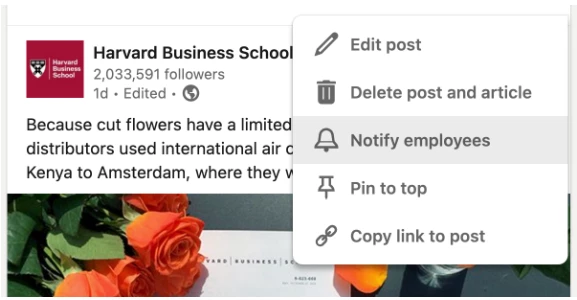
One of my favorite ways to give employees a nudge is by using built-in tools on social media platforms. LinkedIn is HBS’s strongest and most engaged social channel, and we’ve helped elevate that by using the “Notify Employees” button on key pieces of top-performing content.
Essentially what this does is send a push notification to folks who list HBS as their employer on LinkedIn. It simply encourages them to check out the post we sent out—and we’ve noticed an increasing correlation between pushing that magic Notify button and an increase in likes, comments, and shares for those selected content pieces.
I hope these steps are helpful in thinking about how to use employees as your best content advocates. There are many ways you can grow from here—encouraging employees to create unique content, featuring key members of your organization in a curated content series, or building up your program by rewarding participants.
Next week, we’ll dive into some community management/engagement best practices and how to measure success for your engagement strategy effectively.
But for now, here’s what I’m curious to know from you: Have you ever started or been part of an online employee advocacy program? If so, I’d love to hear more about what worked for you and your team and what lessons you learned!