



Experts: Creating Engaging Social Media Content: A Guide to Building Sustainable Community
“So, how do I create content that people will actually, you know, like? And engage with?”
When I sit down with a campus partner or a faculty member to discuss their social strategy, this is probably one of the first questions I’ll be asked.
And it’s a really important question for anyone looking to foster a sense of community with their online social media presence to ask. I truly believe that community is at the core of the social media experience, no matter what industry you’re in or what your end goal is.
There’s that old phrase: “If you build it, they will come.” Okay, sure. But here’s the thing. Community is built out of and then sustained on strong, meaningful relationships. That means after you build it, you need to maintain it. So how do you do that, especially when the community is virtual? Well, engaging content is a great base for that.
Another question I get is: “Can you help me go viral?” I want to emphasize that going viral isn’t a formula—it’s often just a mix of the right content, circumstances, and platform. And a viral post isn’t necessarily the best-engaged post. Impressions and views are key metrics that go hand in hand with popular posts. But those are vanity metrics, not community-building measures of impact.
Community-based content needs to hit a few different touchpoints to be effective. You need to know what you’ve built and what you’re working to maintain and grow. The easiest way to figure that out is to ask yourself some questions. Here’s the set I use to determine how to get started in figuring out what works:
Ask yourself: Who is my audience? What do they want/need?
- What are they curious about? What are they missing information on? What do they know about but want to dive deeper into?
First, you need to know who your audience is so you can figure out the above questions. Are there buyer/customer personas that already exist for your brand? If so, you can leverage these to learn more about your primary audience. If not, here are some things you can dig into:
- What are some of the key demographics for your audience? (Some great ones to start with are location, industry, and age group)
- What problem does your product or service solve, and who generally has that problem?
Now that you’ve answered the “who,” you must find the “why.” Depending on your brand’s focus, there are a few ways you can figure this out. Here are some ideas to think about to get started:
- What comments and DMs are you seeing on your posts and in your inbox? Are there common questions and themes?
- If you Google the problem that your brand set out to solve, what do you find? Are there conversations happening on Reddit? In Facebook Groups? Yelp?
- What are your customers actually saying? Consider using a survey tool or built-in components of social platforms, like polls and comments, to gather information.
Knowing what the pain points of your followers are can help you figure out how to give them a meaningful experience that they can shape the conversation around, keeping them interested in what your brand is saying. There’s unity to be found in common frustrations, questions, celebrations, and experiences—leverage that to build a tight-knit group of end users interested in leveraging each others’ experience and expertise.
Ask yourself: What kinds of content gets the most engagement from my audience already?
How is the view count on your existing suite of videos? Do people actually click through on links you post to your website? Have you tried polls and in-Story add-ins on Instagram? And if so, are people responding?
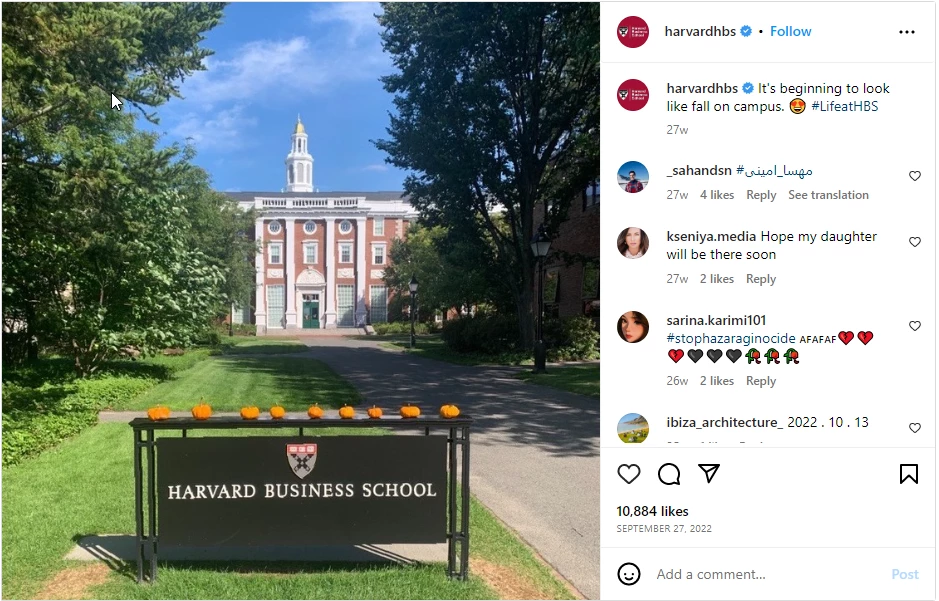
Knowing what your audience is already paying attention to is great because it allows you to leverage high-performing content with minimum effort. We know that two segments of our audience respond quite well to photos of different areas of campus: alumni and prospective students. HBS alumni often comment with specific, nostalgic memories of their time in the MBA or Ph.D. program. Prospective students will talk about how they hope to be part of the community someday or how they envision themselves on campus as well. Incorporating more of those into our strategy has helped us keep those folks connected online, mimicking the way they feel on campus when visiting for annual reunions or tours before they apply.
Ask yourself: What’s going on in the world?
What are the current trending topics on social media? What’s in the news? What holidays, events, etc., are on the horizon?
Keeping tabs on what is happening outside of your brand is a great way to make sure your voice is being positioned as a thought leader in your space.
For example: At HBS, a lot of our content is very timely and relevant to what’s happening right now in the business world. When I look at sharing content on the HBS channels, I always look at where the conversation is for the day. What’s being reported in the news, and what are people either thrilled about or enraged with? And in what ways should HBS’s brand voice be mindful of these reactions when sharing content based on that topic of conversation?
Taking a step back to do a bit of social listening can help you determine where your audience’s mindset is and where the broader mindset of the online space is. Then, you can use this to determine whether your messaging will be effective in continuing the conversation in the tone and topic framework you’d want.
Ask yourself: What do I want my audience to do?
Something crucial to remember: a strong call to action is still warranted, even if you think it may be obvious.
Your audience needs to be clear on what you want them to do. Do you want them to list something in the comments of your post? Add that as an end tag to your copy. Do you need them to RSVP for an upcoming webinar? Remind them, and add the live link to do so.
A clear CTA is a starting point for engagement. Invite them to ask questions, share their experience, and engage with one another. Often, you’ll notice the interactions keep flowing after the first. That’s where it all begins.
Next time, I’ll discuss ways to build and leverage internal engagement (read: employee advocacy) to help fuel the conversation with your external audience.
In the meantime, I’m curious:
Are there other questions you ask yourself about building content for your community? What else are you curious about?
Let me know in the comments below.