



Singapore DDC Workshop Recap 🇸🇬 We're not here to measure, we're here to provide strategic intelligence
In Singapore last week I ran a workshop at Meltwater's Summit on Tour. Over 350 people at the event, and alongside a panel discussion on Data-Driven Communications (recap coming later this week), I ran a dedicated session for a packed room of 80.
We covered a lot!
- Meltwater and Gartner research — the challenges and trends shaping comms and PR right now
- The purpose of communications — why we aren't measuring the thing we're actually paid to deliver
- Team structure and organizational design — the setup a real center of excellence needs to deliver actionable insight
- The 4 levels of analytics maturity — going from describing what happened to handing your execs a strategic recommendation
- The 6 data sources of DDC — the ingredients every comms measurement lead should be working with
- The new customer journey — Reach to Revenue, by way of Relevance and Reputation
- The DDC Compass — the steps anyone can follow to start delivering measurable impact within 90 days
For those who weren't in the room for the analogies and the energy, I want to go deep on the most neglected part of all of it: the 4 levels of analytics.
Execs don't want more data. They want more answers.
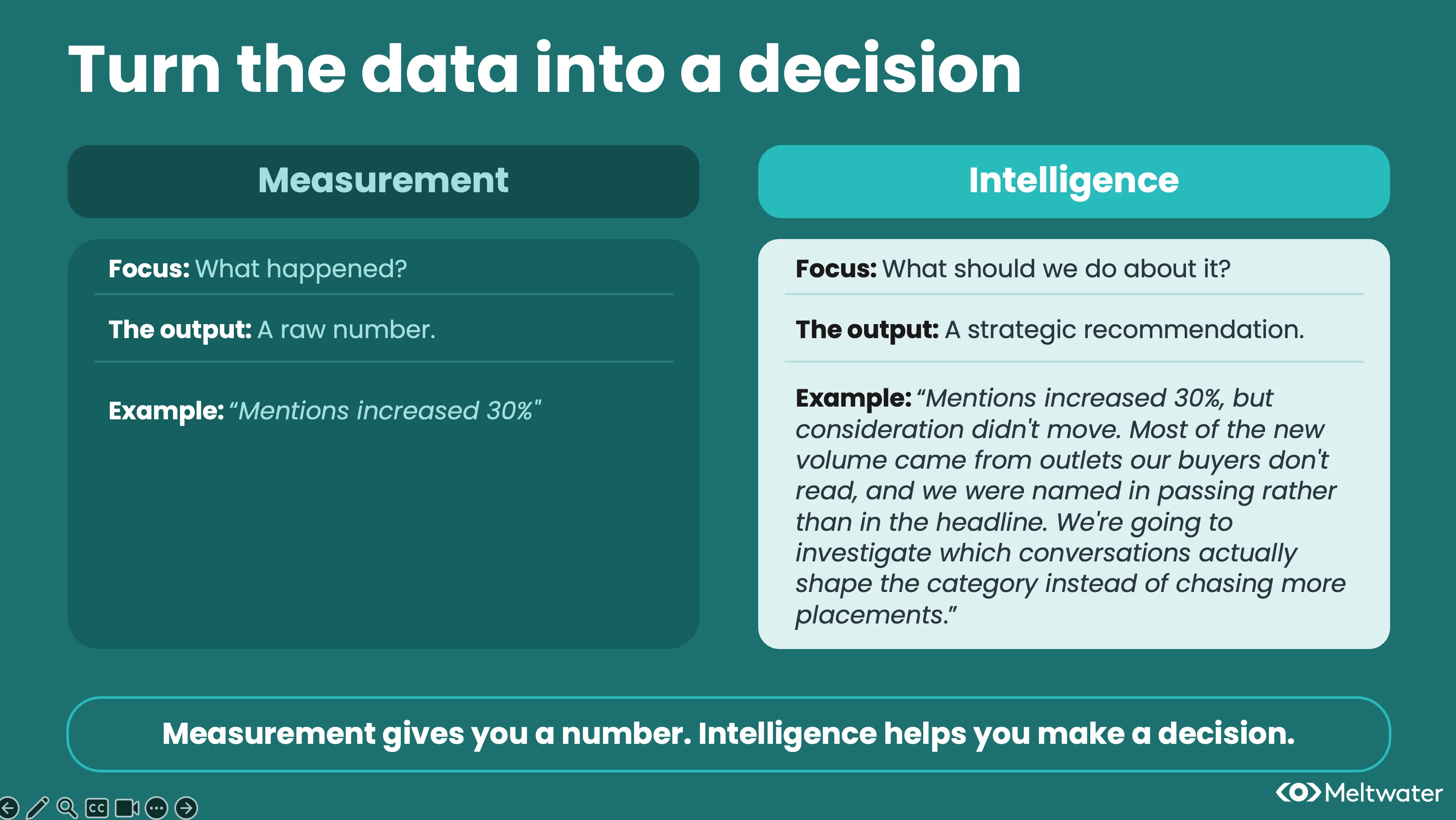
Most clients I work with are struggling to satisfy leadership's appetite for "more data." But that ask is a miscommunication. When an exec says more data, what they want is more answers. Sometimes they say it out loud and sometimes they leave it unsaid, but every exec is asking "so what?" and "now what?"
They don't want us to tell them what happened. They want to know why it happened, what's coming next, and what we recommend doing about it.
For a lot of people, data is the part of the job that sucks. And the part that sucks most is trying to make meaning out of a pile of disconnected data points. I say disconnected because other people genuinely don't see the link between the number we care about and the number they care about. We talk reach and impressions. They talk budget and revenue.
I won't pretend that's easy to bridge. But we'll never build the capability if we don't know what good analysis actually looks like.
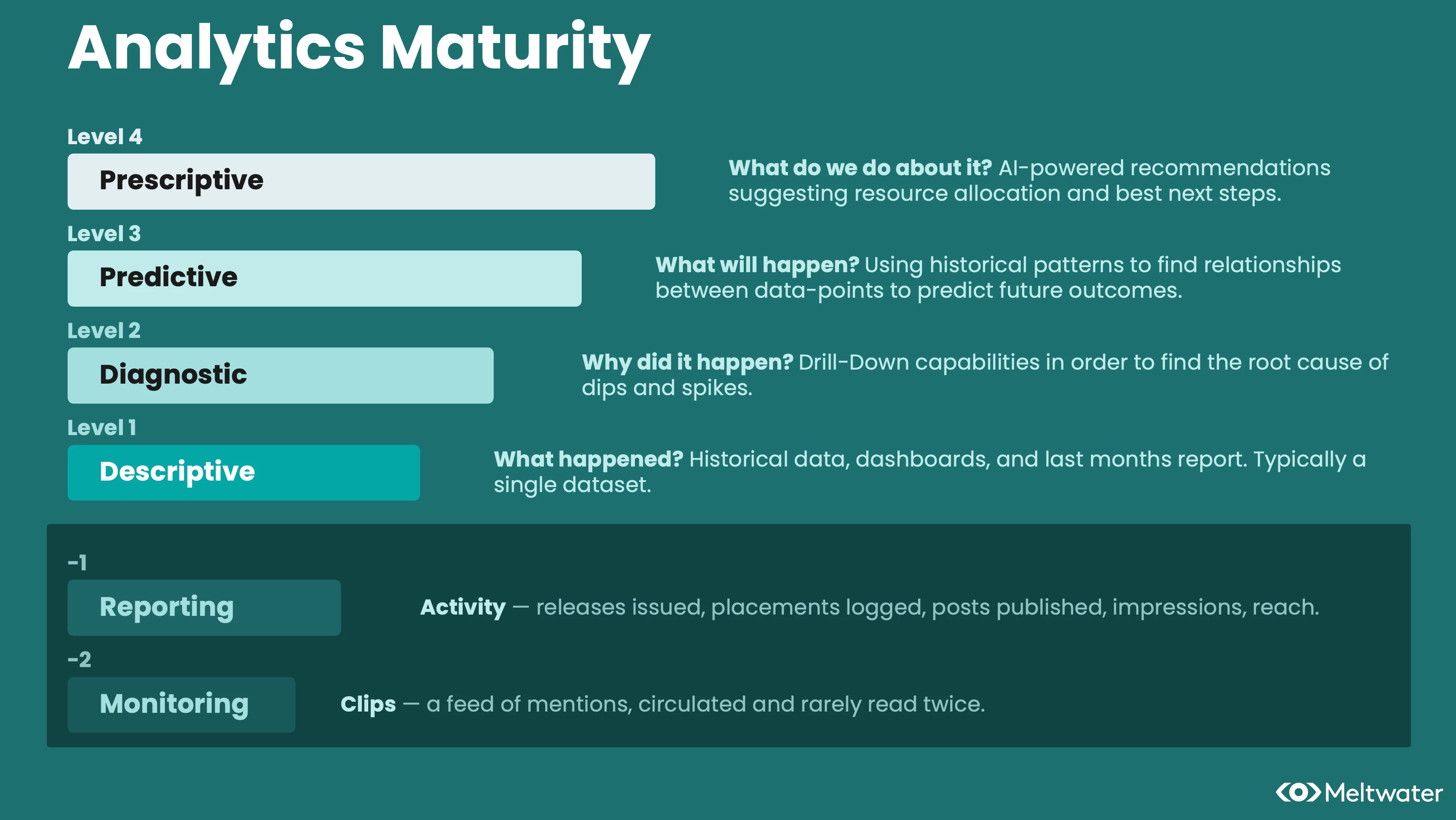
The four levels
Each level answers a different question, and they stack in the order an executive asks them:
- Descriptive — what happened. Share of voice was up 12% this quarter.
- Diagnostic — why it happened. It rose because a competitor went quiet during a leadership transition, not because our output changed.
- Predictive — what happens next. They'll be back in market in Q3, so expect that gain to reverse unless we hold the ground now.
- Prescriptive — what we should do about it. Move the product launch announcement into July and own the category conversation while they're rebuilding.
Below all four is the basement: an activity dashboard that reports what we did. That isn't measurement and it isn't insight. It answers no question at all.
It's very easy these days to produce an elaborate report. There's data everywhere and AI will make you a beautiful chart in seconds. What still takes rigor is producing a recommendation.
But it's more achievable than it looks, because the levels build on each other. A quarterly share of voice pie chart still needs you to say why it moved, and that usually means digging in to explain why a competitor rose or fell. Once you can answer why, a prediction gets much easier, because you can read the season, the events calendar, the trends you're already watching. And once you can predict, the prescription almost writes itself.
The truly scientific version is more complex, but it's the same sequence. More data, more testing, same four questions.
This applies at all three points where you use data
Data-driven communications uses data in three distinct workstreams, and none of them survives on descriptive alone:
- Research happens before decisions are made. You determine what the outcome needs to be and design the inputs to get there. The learning here tells you what your strategy and tactics need to look like.
- Measurement happens once the strategy is set. Your KPIs tell you whether you're putting in the right effort, and the right kind of effort, in time to course correct while the campaign is still live.
- Evaluation happens after. You look back at the outcomes you wanted and judge whether the effort achieved them. This is what tells you whether the campaign worked and how to sharpen the next one.
All three matter equally. And none of them works if you only collect data and answer "what happened."
Score your own last report or dashboard
Pull up the report you most recently sent to your execs. Go through it section by section, and score each headline rather than the whole document, because the headline is where the level actually shows.
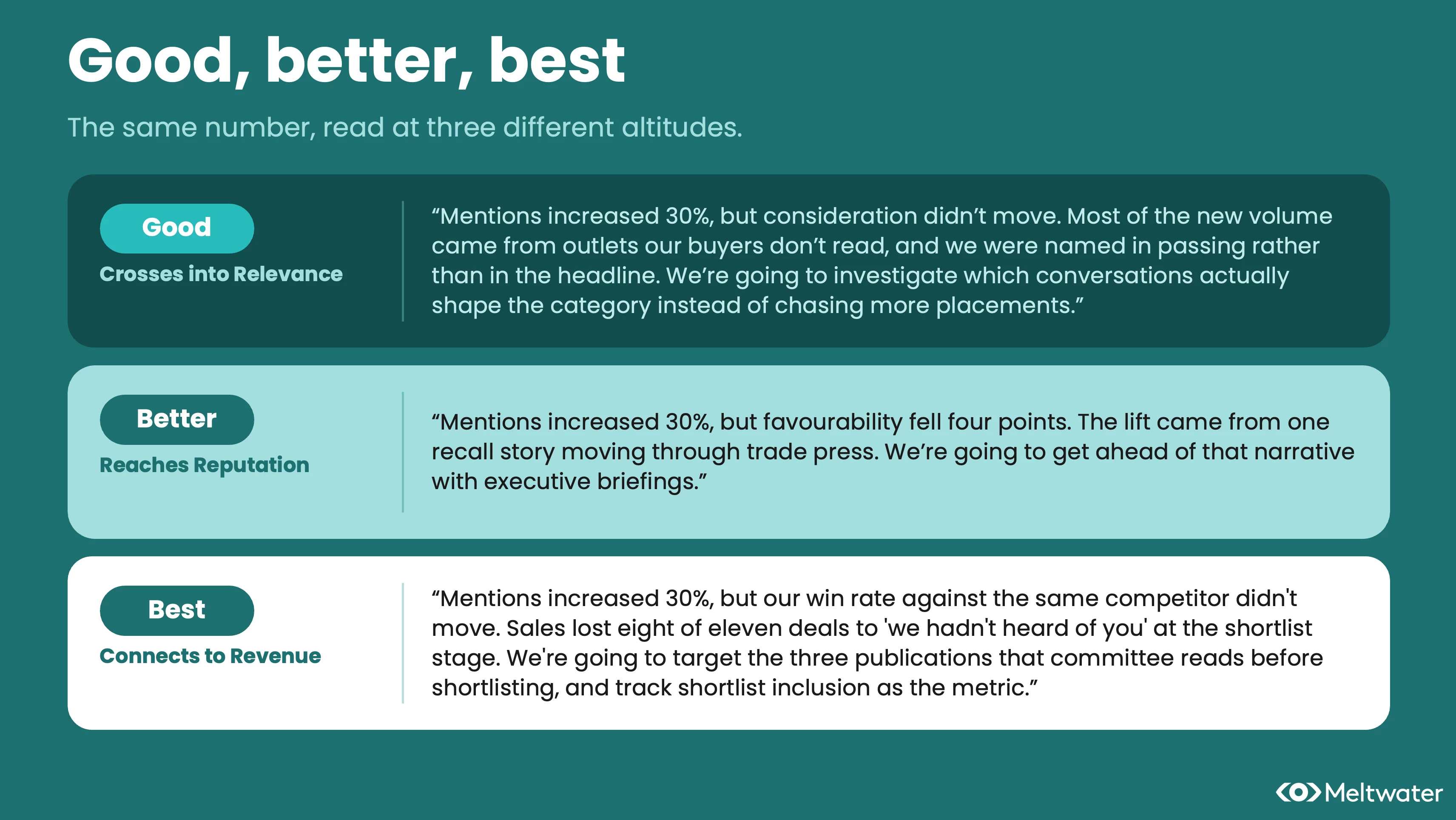
- Does it say what happened? That's a 1.
- Does it explain why? That's a 2.
- Does it say what's likely to happen next? That's a 3.
- Does it recommend a specific action someone could start this week? That's a 4.
Then look at the mix:
- Mostly 1s. This is a monitoring report. Your execs are doing the analysis themselves, or more likely not doing it at all.
- 1s and 2s, no 3s or 4s. You're explaining the past well. Nobody can act on it. You’re letting them interpret the findings themselves, which means they’re still carrying the cognitive load they’re paying you for.
- A 4 buried on slide 9. The most common pattern I see, and the most frustrating... people do the work and lead with the wrong thing.
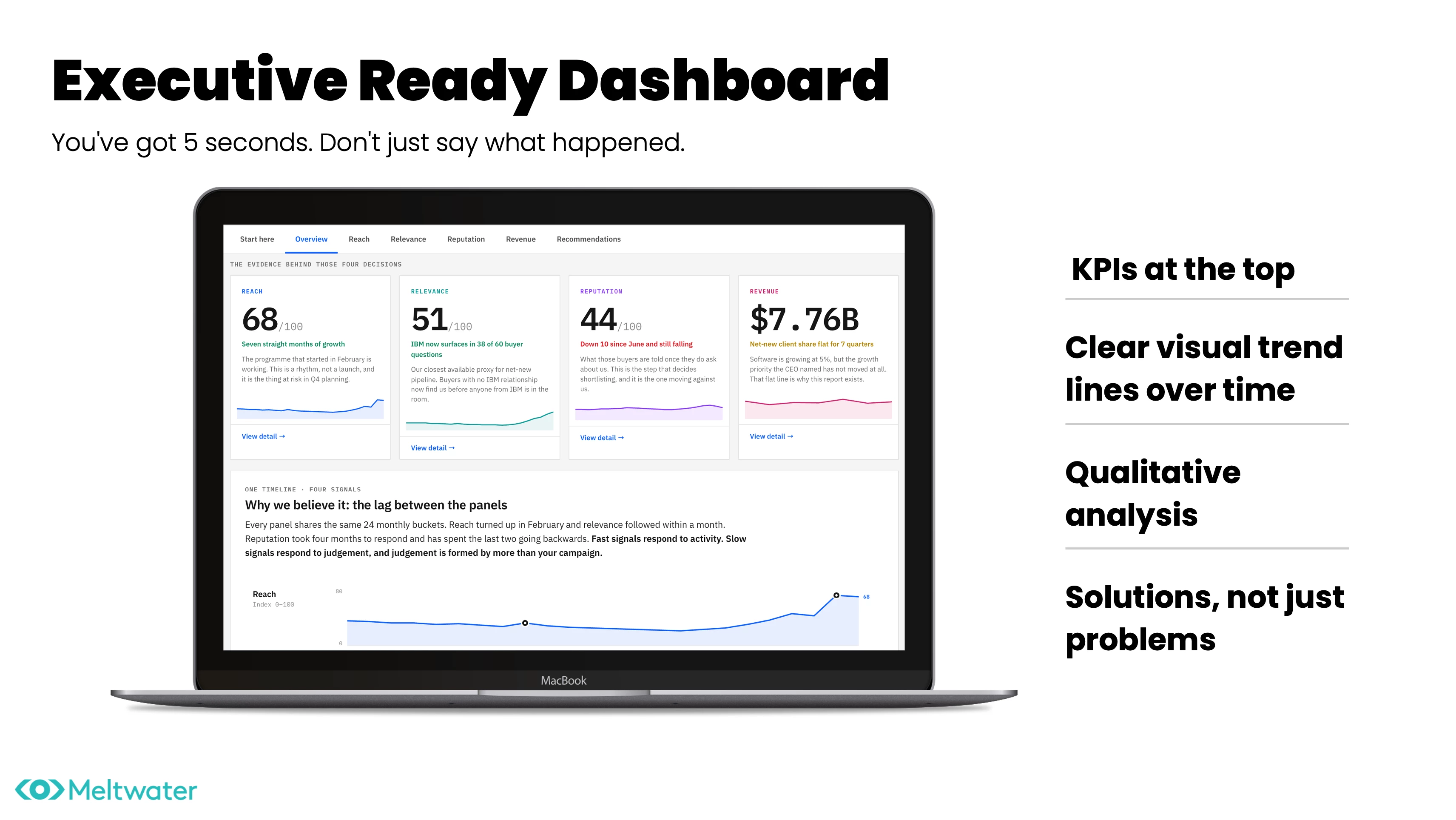
- A 4 up front, with 1s and 2s underneath as evidence. That's an executive-ready report!
One honest note on scoring. A recommendation only counts as a 4 if it names a specific action, within your reader's control, that a named person could start this week. "We should increase engagement" is a 1 wearing a 4's clothing.
Send me your report
Email me at dino.delic@meltwater.com with the report you currently use to demonstrate impact to your execs, and I'll run it through the diagnostic I built (it's a Claude Skill, attached) and send you the full results.
The best part is that the Claude skill practices what it preaches. It doesn't just tell you what level you're at. It tells you why, and it gives you a recommendation for getting to the point where you can predict and prescribe.